Félix D. Almaráz, Jr.: A Legacy in Borderlands History (1933–2023)
Published: January 27, 2024
Updated: January 27, 2024
Félix D. Almaráz, Jr., nationally and internationally-known historian, author, educator, and Spanish Borderlands scholar, was born in San Antonio, Texas, on December 2, 1933, to Félix D. Almaráz, Sr., and Antonia (Rodríguez) Almaráz. He had a younger brother, Roberto. He grew up wanting to be a writer and a history teacher. He attended South San Antonio High School and received his diploma in May 1952. The following year, during the Korean War, Almaráz enlisted in the United States Army and was stationed at Andersen Air Force Base in Guam and assigned to an aviation engineer battalion. During his off-duty hours, his interest in writing and history provided him the opportunity to visit the base library and write stories for the Pacific Edition of Stars and Strips. He was also an announcer on Armed Forces Radio and was later stationed at Fort Bliss.
After his tour of duty and with financial aid from the G. I. Bill, Félix Almaráz enrolled at San Antonio College and received his associate of arts degree in 1957. Being fully aware of the distinguished reputation of the history scholar Dr. Joseph W. Schmitz, Almaráz transferred to St. Mary's University and in 1959 received his B.A. degree (magna cum laude) in history along with a secondary teaching certificate. In September 1960 he found a teaching job in the Harlandale Independent School District (ISD) in San Antonio, and at night he enrolled in graduate school to study Spanish Borderlands history under the tutelage of Schmitz, who became his mentor. Almaráz remained with the Harlandale ISD into 1964.
On August 12, 1961, Félix D. Almaráz, Jr., married María Guadalupe Olivares in San Antonio; they later had a son named Antonio. Almaráz received his M.A. degree in history from St. Mary’s University in 1962. In 1964 he moved with his family to Albuquerque to attend the University of New Mexico and pursue a doctoral degree. During his studies, he also worked as a historical information analyst for the U. S. Atomic Energy Commission at Los Alamos during the summer of 1966. While attending a Western History Association Conference in 1966, Almaráz met artist José Cisneros who later illustrated many of his books and essays. Their friendship lasted more than four decades.
In 1967, while working on his dissertation, Almaráz moved his family back to San Antonio and worked as an assistant professor of history at St. Mary's University. He obtained his Ph.D. from the University of New Mexico in June 1968, and two years later he accepted an associate professor of history position at Pan American College (now the University of Texas-Pan American) in Edinburg, Texas. During the spring semester in 1971, he accepted a visiting associate professor of history at the University of Texas at Austin.
Through professional friends in Austin and San Antonio, he found out that the University of Texas was planning to open a new branch in San Antonio. He was very much interested in working for the new university and was highly encouraged to do so by Arleigh B. Templeton, first president of the new university. Almaráz quit his job at the University of Texas at Austin and accepted the position of director of the fledgling Bilingual/Bicultural Program, a Title VII federally-funded project for elementary students, in the South San Antonio ISD.
In 1973 Almaráz joined the faculty of the new University of Texas at San Antonio (UTSA) as the first associate professor of history in the Division of Behavioral and Cultural Sciences. During his tenure at UTSA, he taught courses at the graduate and undergraduate level in the history of Texas (Colonial and Modern), Latin America, Spain, Mexico, cultural origins of San Antonio, history of South Texas, and the Spanish Borderlands. Noted for his commanding presence in the classroom, Almaráz also served as master of ceremonies at the annual commencement exercises. His role as host became a tradition—he carefully pronounced the name of each undergraduate and graduate student correctly.
In 1988 Almaráz received a Fulbright Senior Lectureship to Argentina for six weeks where he successfully delivered guest lectures on Texas history at universities, libraries, and institutions. In 2003 he was selected a Piper Professor by his colleagues, under the auspices of the Minnie Stevens Piper Foundation. In 2005 he was named Peter T. Flawn Distinguished Professor of Borderlands History, one of the highest honors UTSA bestows on a faculty member. In August 2011, after thirty-eight years of service, and having attained tenure as a full professor, Almaráz retired with the honorary title of professor emeritus of history.
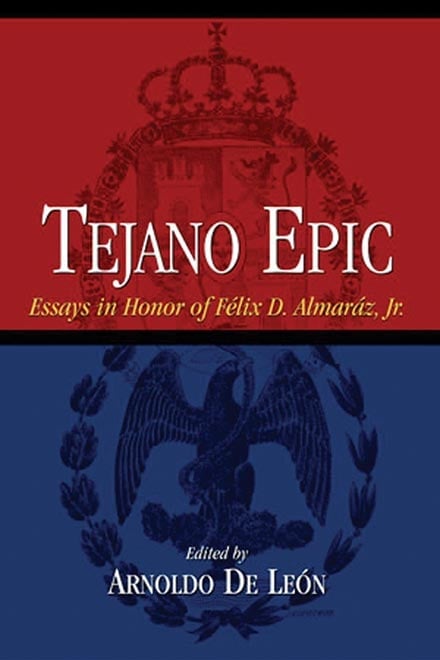
In addition to his teaching duties, Almaráz was a member of the executive council of the Texas State Historical Association (TSHA) for twelve years. He also served on the editorial board of the Southwestern Historical Quarterly, a publication of the TSHA. The organization designated him a “Fellow” in 1986 in recognition of his many contributions to historical research and writing. He was awarded a life membership in the TSHA and served as its vice president from 1993 to 1995 and as president from 1995 to 1996. In 2005 the TSHA paid special tribute to him by publishing a book titled, Tejano Epic: Essays in Honor of Félix D. Almaraz, Jr. The editor, Arnoldo De León, and all the other seven distinguished historians who contributed essays were his colleagues. Noted in Tejano Epic as “a scholar and a gentleman who has amassed a record of exceptional achievement in his chosen career,” he was heralded by both students and colleagues for his scholarship, charismatic style of teaching, and consummate professionalism.
When Almaráz began his academic career at UTSA, the Bexar County Historical Commission offered him an appointment as chairman of their Markers Committee which he gladly accepted and remained in that position for forty-eight years until 2021. Under his leadership the committee received approval for many historical markers across Bexar County. Serving as an ambassador for the Alamo City, Almaráz played an instrumental role in several historic events. In 1984 he traveled to Madrigal de las Altas Torres, the birthplace of Spain's Queen Isabel the Catholic, to present a bilingual plaque to the mayor and town council as a gift from the residents of Bexar County to celebrate the 500th anniversary of Columbus's voyage of 1492. In 1987 he hosted and led a number of bishops from Mexico to San Antonio to meet with Pope John Paul II and attend the Papal Mass. In 2003 Almaráz led a delegation from San Antonio to the Canary Islands to strengthen the cultural and historical relationship that began in 1731 when a group of fifty-six Canary Islanders settled in what is now San Antonio. He and his family made four more trips that led to his involvement in coordinating a second international symposium—"II International Symposium Canary Islands—Texas: The Historical Connection" supported by the Friends of the Canary Islands Foundation and UTSA. His work for the city of San Antonio and for the county continued when he organized a three-year Tricentennial Symposium, "Spain's Encounter with the New World," and was also successful with the World Heritage nomination for the San Antonio Missions. County commissioners recognized his work by honoring him with multiple Hidalgo Awards, Bexar County’s highest award given in recognition for service to the community.
Almaráz was actively involved in numerous organizations and projects, and the following represent a very small sample. He was the conference director on "The Role of Latin American History in the High School Curriculum," that took place at St. Mary's University (1969). He was president of the Texas Catholic Historical Society from 1981 to 1984 and served on the editorial board of its journal, the Catholic Southwest: A Journal of History and Culture, as well as on the boards of a number of other journals. He was a member of the Texas Historical Records Advisory Board (1993–95) and on the Advisory Commission of the San Antonio Missions National Historical Park (1983–89). Moreover, he was president of the San Antonio Historical Association, and for two decades he narrated the Los Pastores pageant at Mission San José.
He was a presenter at several of the annual Inter-American Bookfair and Literary Festivals in San Antonio and made presentations at different educational institutions throughout the state as a member of the Humanities Speakers Bureau, sponsored by the Texas Council for the Humanities. On March 21, 2015, Almaráz organized a conference on "Sor María de Jesús de Agreda—The Lady in Blue and the Founding of the First Texas Missions" at St. Mary's University where he invited a thirty-five-person delegation from Spain, led by the mayor of Agreda.
A dedicated researcher, Almaráz worked with English and Spanish records in the United States, Mexico, and Spain and published many scholarly essays. He presented his research findings at conferences in Texas, Mexico, Sweden, Spain, and Vatican City. For example, on September 24, 2016, he presented a paper on "The Father with Winged Feet, Fr. Antonio Margil De Jesús, OFM," at a conference sponsored by the Archdiocese of Denver and the Pontifical Commission for Latin America.
He wrote more than fifty books and monographs and has been recognized for his contribution to the field of the Spanish Borderlands. His award-winning books include Tragic Cavalier: Governor Manuel Salcedo of Texas, 1808–1813 (1971), The San Antonio Missions and Their System of Land Tenure (1989), and Knight without Armor: Carlos Eduardo Castañeda, A Biography of a Mexican American Historian 1896–1958 (1999). He also wrote the foreword and preface for many books on Texas history and edited and co-authored many more books. For two years, he wrote a series of sixty-two articles for the San Antonio Express-News, beginning with his first article, "Coahuila, Texas joined in founding of Mexico," in the April 22, 1992, edition.
In 1996 Almaráz was invited by the Arts and Humanities Council of Tulsa, Oklahoma, to participate in the Chautauqua Festival and portray Senator Sam Houston and Edward R. Murrow, and afterwards, he made numerous appearances before different educational and cultural organizations throughout Texas. He was also the consultant for the two-hour documentary in English and Spanish, Texas Before the Alamo (2013), a story of the founding of Texas through Spanish soldiers and priests who established missions, presidios, and trails. In addition, he portrayed a Franciscan friar.
Almaráz received many awards and honors during his lifetime. In 1979 he received from the Mexican government the El Aguila de Tlaltelolco and the Capitán Alonso de León Medal of Honor and Diploma. In 1981 he was inducted into the Equestrian Order of the Holy Sepulcher of Jerusalem. His writings earned the Sons of the Republic of Texas Presidio La Bahía Award four times, and in 2002 he was elected to the Texas Institute of Letters. In 2003 Almaráz received the Medal of the Order of Civil Merit by King Juan Carlos of Spain for his commitment to research and compositions about northern Mexico and the Southwestern United States. The award is one of Spain's highest honors. That same year he was presented with the Francisco I. Madero Award (statuette). In 2009 he received the prestigious Arts and Letters Award from the Friends of the San Antonio Public Library.
At the time of his death, Almaráz was involved with several projects. Among them, he held the seat of the Distinguished Research Scholar-in-Residence at St. Mary's University; was working on a new book, an English-language translation of a diary kept by eighteenth-century Franciscan friar Juan Agustín de Morfi; and initiated the Almaráz Research Institute of Borderlands History and Culture. Félix D. Almaráz, Jr., at the age of eighty-nine, died in San Antonio on March 22, 2023. He had divorced in 1981 and in 1985 married Dolores Marie Cardona, who survived him. They had a daughter, Felisia. His funeral Mass was held at St. Luke Catholic Church in San Antonio, and he was buried in Fort Sam Houston National Cemetery.
Bibliography:
Félix D. Almaráz Papers, UA 99.0009, University of Texas at San Antonio Libraries Special Collections. Félix D. Almaráz, Jr., Ph.D., “The Professor and the Three Gilbertos,” Gold & Blue St. Mary’s University, Alumni Magazine, Winter 2000. Arnoldo De León, ed., Tejano Epic: Essays in Honor of Félix D. Almaráz, Jr. (Austin: Texas State Historical Association, 2005). Obituary of Félix D. Almaraz Jr., Hillcrest Funeral Home Burial Park & Cremations (https://www.hillcrestfuneral.net/obituary/felix-almaraz-jr#:~:text=Almar%C3%A1z%20passed%20away%20on%20March,Robert%20soon%20joined%20the%20family.), accessed January 9, 2024. San Antonio Express-News, July 15, 1984; October 28, 2018; August 11, 2021; March 23, 2023; April 3, 2023. Nick Ward, "In Memoriam: UTSA remembers historian and long-time faculty member Felix Almaráz, Jr." UTSA Today, May 26, 2023 (https://www.utsa.edu/today/2023/05/story/in-memoriam-felix-almaraz-jr.html), accessed January 9, 2024.
Categories:
Time Periods:
Places:
The following, adapted from the Chicago Manual of Style, 15th edition, is the preferred citation for this entry.
J. Gilberto Quezada, “Almaráz, Félix Diaz, Jr.,” Handbook of Texas Online, accessed March 09, 2026, https://www.tshaonline.org/handbook/entries/almaraz-felix-diaz-jr.
Published by the Texas State Historical Association.
TID:
FALMA
All copyrighted materials included within the Handbook of Texas Online are in accordance with Title 17 U.S.C. Section 107 related to Copyright and “Fair Use” for Non-Profit educational institutions, which permits the Texas State Historical Association (TSHA), to utilize copyrighted materials to further scholarship, education, and inform the public. The TSHA makes every effort to conform to the principles of fair use and to comply with copyright law.
For more information go to: http://www.law.cornell.edu/uscode/17/107.shtml
If you wish to use copyrighted material from this site for purposes of your own that go beyond fair use, you must obtain permission from the copyright owner.
- January 27, 2024
- January 27, 2024
This entry belongs to the following special projects: