Brackenridge Park Golf Course: A Historic Texas Landmark
By: Lewis F. Fisher
Published: April 29, 2025
Updated: April 29, 2025
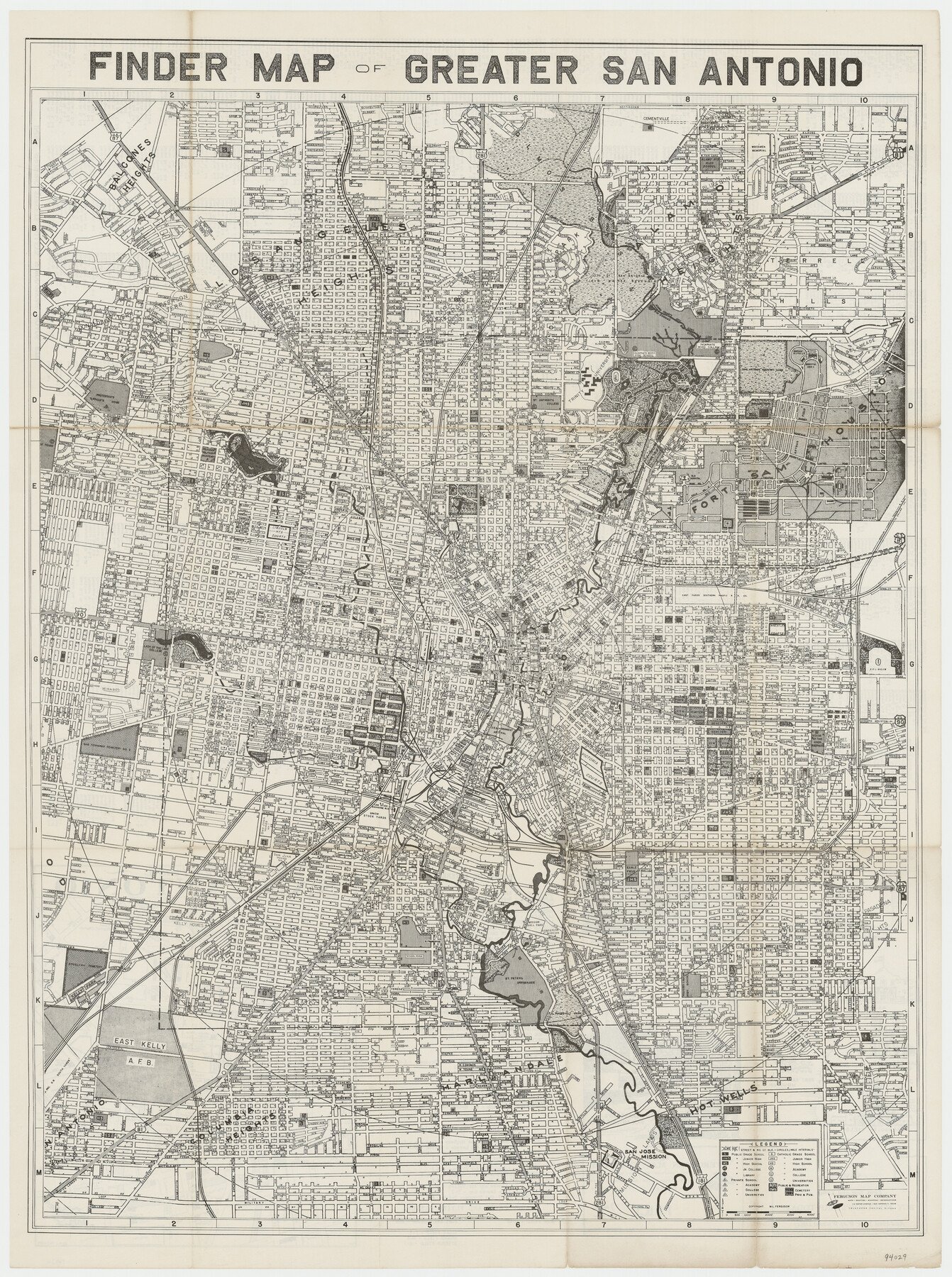
San Antonio’s Brackenridge Park Golf Course, which opened in 1916, was the first eighteen-hole public golf course in Texas and the original home of the Texas Open. In June 1915, during his first month as parks commissioner, Ray Lambert addressed the long-expressed municipal goal of building tourism by having a public golf course in the city. The site selected was most of the southern half of George Brackenridge’s 1899 gift for parkland of some 200 acres a short distance southwest of what would become the corner of Broadway and Hildebrand Avenue. That area, however, hosted a popular menagerie of wild animals that included bison Brackenridge purchased from North Texas rancher Charles Goodnight in 1903 and donated to the city. To house the animals Lambert created the San Antonio Zoo at the northwestern corner of Brackenridge Park.
To design the course the city hired Albert Warren Tillinghast, age thirty-nine, who went on to become one of the nation’s leading golf course designers. In October 1915 Tillinghast spent two weeks supervising clearing of the site and the initial construction, followed by ten days of consultation while he was designing the eighteen-hole Funston Moor Golf Course for the U.S. Army at nearby Fort Sam Houston. Work was completed under assistant city engineer W. S. Delery.
Tillinghast had to contend with two waterways—the San Antonio Water Works raceway canal, which bisected the area planned for the upper nine holes, and the San Antonio River, its meanders causing design challenges for seven of the nine southern and southwestern holes. Also, three public roadways were still to pass through portions of the course. Tillinghast finessed some of the obstacles with his signature “reef bunkers,” a series of sand bunkers that crossed the fairway diagonally at two holes.
Still standing inside the course’s northeastern perimeter was the clubhouse built in 1894 for the San Antonio Jockey Club’s since-removed racetrack and later used as a military officers’ club by the Spanish-American War-era Camp Mosby and Camp Capron. At the time the home of a park gardener, the structure became the temporary golf course clubhouse. The building was rewired and got eighty lockers and hot and cold showers. The Gunter Hotel provided complimentary towels. The first floor was reserved for male golfers and the second for female golfers.
The first nine holes of what was first named Brackenridge Park Golf Links (the San Antonio Evening News referred to the course as Brackenridge Municipal Links) opened in February 1916, and the second nine holes opened seven months later. The course’s quick success led San Antonio Evening News sports editor Jack O’Brien and course pro John Bredemus to organize the state’s first professional golf tournament, the Texas Open, in February 1922. Its purse was $5,000 (the equivalent of upwards of $90,000 or more in the mid-2020s), three times the purse of the U.S. Open at the time. In the February 2, 1922, edition of the San Antonio Evening News, Jack O’Brien reported, “With a field of nearly 90 players, the Texas Open Championship has assumed proportions far beyond the expectations of the most optimistic.” More than 6,000 spectators came daily. The Texas Open was held annually at Brackenridge more than twenty times during the next Thirty-seven years and attracted golfers from Ben Hogan to Arnold Palmer to Lee Trevino. It has since been held at the Oak Hills Country Club golf course—also designed by Tillinghast—and at other courses in San Antonio.
Also in 1922 the Brackenridge Women’s Golf Association, one of the first such women’s groups in Texas, was formed. One early member was Elizabeth Fucals, among the first Black women to play on a Texas course.
Given the response to the first Texas Open, civic leaders raised funds to hire noted architect Ralph H. Cameron to design a two-story Tudor-style stone clubhouse, with a great room and large fireplace, southwest of the initial club house, which was razed. The new building was finished in time for the second Texas Open, in 1923, and Murray Brooks was hired as course manager. Brackenridge became the home course for the National Pan American Golf Association, organized by Mexican American players in San Antonio in 1938. Two years later Brooks aided planning and construction by the National Youth Administration of a stone starter house, caddy house, tee boxes, drinking fountains, and five bridges for golfers to cross the Water Works canal and the San Antonio River.
An interstate highway completed as U.S. 281 was routed along the western edge of Brackenridge Park to curve sharply at the park’s southwest corner through the golf course’s twelfth hole. It would cost the course ten acres and lead to major changes in 1968 that erased Tillinghast’s design of the lower nine holes. In the area of the upper nine, intruding roads were closed and most of the river’s meanders filled along with the abandoned Water Works canal, leading to removal of three of the five NYA stone bridges.
In 2005 planning began for a $4.5 million project overseen by the new Municipal Golf Association-San Antonio, later known as Alamo City Golf Trail. The course was closed for a year while Texas golf course designer John Colligan oversaw restoration of fifteen of the eighteen holes to Tillinghast’s original design, reopening riverbed meanders in the process. The project of the course, covering 113 acres, was completed in 2008. The restored clubhouse included a Texas Golf Hall of Fame and Museum, joined by a “Walk of Fame” nearby.
Across the way stood the two-story pump house built of ashlar limestone blocks by George Brackenridge’s San Antonio Water Works Company in 1885 at the same time as its raceway canal. From 1925 to 1937 the pump house was rented as a studio by sculptor Gutzon Borglum, who completed his early designs of Mount Rushmore there. The renovated structure is rented out by Alamo Golf Trails as a special events venue known as the Borglum Studio.
In 2011 the bridge along Millrace Street from Broadway to the clubhouse gained a series of golf-related ceramic panels by Diana Kersey, one portraying course designer A. W. Tillinghast and another Queenie the Dog, pet of Jack O’Brien, the sports editor who helped establish the Texas Open in 1922. Among its honors, Brackenridge Park Golf Course was an inaugural inductee into the Texas Golf Hall of Fame’s Registry of Historic Golf Courses in 1992. In 2021 Golf Magazine named it one of the thirty best municipal courses in the United States. See also GOLF.
Bibliography:
Brackenridge Park Est. 1916, Alamo City Golf Trail (https://alamocitygolftrail.com/brackenridge-park-golf-course/), accessed April 15, 2025. Lewis F. Fisher, Brackenridge: San Antonio’s Acclaimed Urban Park (San Antonio, Trinity University Press, 2022). Reid E. Meyers, The Ghosts of Old Brack: A Pictorial History of the Brackenridge Park Golf Course (San Antonio, Reid E. Meyers, 2010). Kevin Robbins, It’s Been a Journey: The True Story of the Oldest Golf Tournament in Texas (Valero Texas Open/Legendary Publishing & Media Group, 2022). San Antonio Evening News, February 2, 1922. San Antonio Express-News, July 16, 2021. Texas Golf Hall of Fame: Brackenridge Park Golf Course (https://www.texasgolfhof.org/exhibit/brackenridge-park-golf-course), accessed April 15, 2025. Valero Texas Open: History Overview (https://valerotexasopen.com/history-overview/), accessed April 15, 2025.
Categories:
Time Periods:
Places:
The following, adapted from the Chicago Manual of Style, 15th edition, is the preferred citation for this entry.
Lewis F. Fisher, “Brackenridge Park Golf Course,” Handbook of Texas Online, accessed March 09, 2026, https://www.tshaonline.org/handbook/entries/brackenridge-park-golf-course.
Published by the Texas State Historical Association.
TID:
XVBRA
All copyrighted materials included within the Handbook of Texas Online are in accordance with Title 17 U.S.C. Section 107 related to Copyright and “Fair Use” for Non-Profit educational institutions, which permits the Texas State Historical Association (TSHA), to utilize copyrighted materials to further scholarship, education, and inform the public. The TSHA makes every effort to conform to the principles of fair use and to comply with copyright law.
For more information go to: http://www.law.cornell.edu/uscode/17/107.shtml
If you wish to use copyrighted material from this site for purposes of your own that go beyond fair use, you must obtain permission from the copyright owner.
- April 29, 2025
- April 29, 2025