Belle Christie Ferguson Critchett: Teacher, Suffragist, and Community Leader (1867–1956)
By: Mia Gomez
Published: October 23, 2024
Updated: October 23, 2024
Belle Christie Ferguson Critchett, born on March 9, 1867, to Alexander Ferguson and Isabella (Christie, sometimes listed as Christian) Ferguson in Perthshire, Scotland, was a teacher, suffragist, poet, and community leader. The Critchett family immigrated to the United States in 1870 and settled at Clinton, Iowa. The 1870 U.S. census listed the family at that location, where Alexander Ferguson worked as a blacksmith. After Belle’s father died, her mother supported the family by working as a milliner with the help of the eldest brother. Her mother’s actions instilled in Belle her core values of hard work, education, and success. The 1880 census listed the family still in Clinton, Iowa, where Belle attended local schools. Sometime after that date, the family moved to Denver, Colorado, where she worked as a primary school teacher. She became a naturalized citizen on May 16, 1896.
On February 9, 1901, Belle Christie Ferguson, still a teacher in Denver, married chemist and assayer Otis Adams Critchett, Jr., in Los Angeles, California. They moved to El Paso, Texas, in 1902, where Otis and Belle’s brother George Ferguson owned and operated an assay office called Critchett and Ferguson. Otis and Belle Critchett’s only child, Otis Adams III, was born in 1907 but died later that same year. After his death, Belle Critchett focused her energy on local issues, such as poverty, church work, woman suffrage, and temperance.
Critchett belonged to several progressive organizations, such as the Woman’s Club of El Paso and the First Presbyterian Women’s Aid Society. In 1917 she served as president of the El Paso Equal Franchise League (a chapter of the Texas Equal Suffrage Association and later converted into the League of Women Voters of Texas), of which she was a charter member. In 1918 the Texas Democratic party chairman asked Critchett to recommend a few women to serve as clerks in the July county election. Because the El Paso chapter of the National Association for the Advancement of Colored People (NAACP) supported Critchett, she recommended the names of several African American women after consulting Maude Sampson Williams, chairperson of the African American Women’s League of El Paso. The party chairman “indignantly” denied Critchett’s recommendations, and she had no choice but to turn down Williams’s request.
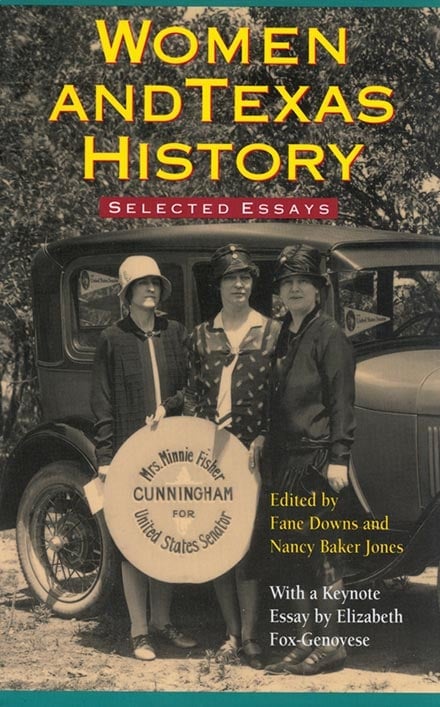
In 1918 Critchett ran for the office of school trustee of the El Paso School Board as the only woman candidate. She had the support of local Democratic party members and fellow suffragists Minnie Fisher Cunningham and Edith Hinkle League. The school board election and Critchett’s candidacy marked a shift toward increased representation of women in local government and woman suffrage as women had gained the right to vote in Texas state primary elections. At a luncheon for Critchett’s endorsement, local leaders urged women to take advantage of their “newly granted right.” Critchett lost the school board election by forty-seven votes.
Critchett served as president of the El Paso League of Women Voters in 1921. During her time as president, she attended several state and national League of Women Voters conferences and wrote to various local and national leaders such as Herbert Hoover, Robert E. Thomason, and Richard M. Dudley to gain their support for women’s rights.
She served as vice president of the Schwingle-Potter Home Association in 1928. She had been a longtime member of its predecessor, the Potter Memorial Home Association, having served on its first board as recording secretary. The association, named after Abigail (Abbie) and Joseph A. Potter and Jacob Schwingle, established the El Paso Home for Aged Gentlefolk, which served El Paso’s elderly community as well as younger people if there was room for additional boarders.
Critchett became involved in the temperance movement in the early 1930s when she organized the El Paso chapter of the Women’s Christian Temperance Union in 1933 and served as publicity chair. She remained active in civic affairs in El Paso. She helped establish the El Paso Home for Girls and was a member of the El Paso Joint Legislative Council. She was a strong advocate for various progressive issues, including prison reform, city beautification, the fight against government corruption, and support for the world peace movement. Additionally, Critchett wrote poetry, and her verses were published in local newspapers, such as the El Paso Times and El Paso Herald-Post, and anthologies. Her poem “Voices” was published in the Anthology of Magazine Verse in 1935, and “Co-operation” appeared in Texas Book of Poets in 1936.
Belle Christie Ferguson Critchett died at her home in El Paso, Texas, on January 6, 1956. She was eighty-eighty years old. She was buried next to her husband, who had died in 1950, in Evergreen Cemetery in El Paso. In 2023 she was inducted into the El Paso County Historical Society Hall of Honor.
Bibliography:
Belle C. Critchett Correspondence, Minnie Fisher Cunningham Papers, Carey C. Shuart Women’s Research Collection, University of Houston Libraries Special Collections. Belle Christie Critchett Papers, 1915–1968, M386, C.L. Sonnichsen Special Collections Department, University of Texas at El Paso Library. El Paso Evening Post, May 30, 1928. El Paso Herald, July 14, 1913; April 5, 1917; April 4, 1918; May 3, 1918; July 13, 1920; April 1, 1921. El Paso Herald-Post, August 14, 1934; June 15, 1935; August 29, 1935; January 13, 1956. El Paso Times, December 10, 1915; February 5, 1936.
Categories:
Time Periods:
Places:
The following, adapted from the Chicago Manual of Style, 15th edition, is the preferred citation for this entry.
Mia Gomez, “Critchett, Belle Christie Ferguson,” Handbook of Texas Online, accessed March 09, 2026, https://www.tshaonline.org/handbook/entries/critchett-belle-christie-ferguson.
Published by the Texas State Historical Association.
TID:
FCRIT
All copyrighted materials included within the Handbook of Texas Online are in accordance with Title 17 U.S.C. Section 107 related to Copyright and “Fair Use” for Non-Profit educational institutions, which permits the Texas State Historical Association (TSHA), to utilize copyrighted materials to further scholarship, education, and inform the public. The TSHA makes every effort to conform to the principles of fair use and to comply with copyright law.
For more information go to: http://www.law.cornell.edu/uscode/17/107.shtml
If you wish to use copyrighted material from this site for purposes of your own that go beyond fair use, you must obtain permission from the copyright owner.
- October 23, 2024
- October 23, 2024
This entry belongs to the following special projects: