Eleanor Roosevelt's Impact and Connections in Texas
By: Mary L. Scheer
Published: April 30, 2025
Updated: April 30, 2025
As a young woman and then as First Lady of the United States, Eleanor Roosevelt was no stranger to Texas. Her earliest known visit to the state took place in the summer of 1912 when she and Franklin D. Roosevelt traversed the entire width of Texas on a second honeymoon. Throughout the Great Depression, with her husband confined to a wheelchair, she became his “eyes, ears, and legs,” crisscrossing the nation, making sure that New Deal agencies maintained their effectiveness. Traveling by train and plane, she visited Texas on many occasions, inspecting a WPA project in El Paso, NYA agricultural programs in College Station, an irrigation project in Harlingen, a job training program at a Houston hospital, and local industries in San Antonio. She also spoke at the dedication of the chapel built by NYA youths at what became Texas Woman’s University. When her son Elliott and his family settled on a ranch near Fort Worth, Eleanor frequently combined her public engagements with visits to see her grandchildren. In her “My Day” columns, she often commented on these trips and described the Texas countryside and cowboy culture, which appeared so foreign to an easterner.
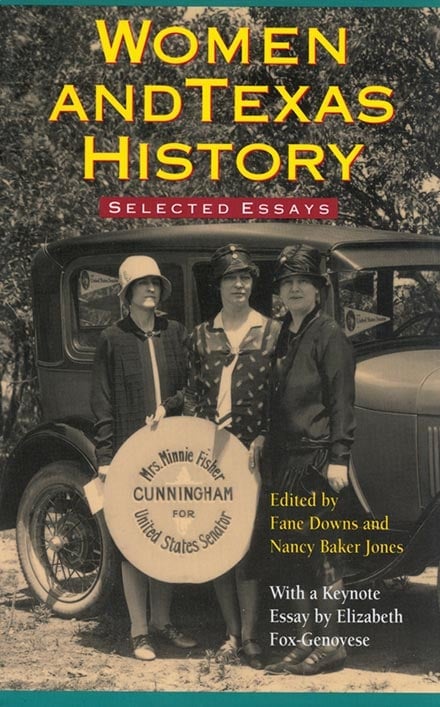
As a social activist with a keen interest in the problems of ordinary citizens, Eleanor had a circle of friends, several in Texas, who were committed to creating a more just society. Although she did not immediately endorse woman suffrage, she became aware of the work of Minnie Fisher Cunningham, the Texas suffrage leader, candidate for the U.S. Senate, and executive secretary of the National League of Women Voters. Cunningham's address at the League's second annual convention in 1921 impressed New York delegate Roosevelt. She later recalled Cunningham’s inspiring words that “you had no right to be a slacker as a citizen, you had no right not to take an active part in what was happening to your country as a whole." In 1924 Roosevelt invited Cunningham to join a special Democratic Women’s Advisory Committee to help draft a platform for the upcoming Democratic National Convention. Her husband Franklin later coined the nickname by which Cunningham became widely known, "Minnie Fish."
During the 1930s Roosevelt corresponded regularly with Anna H. Pennybacker, the Texas educator, clubwoman, reformer, and writer. Twenty-three years older than Eleanor, Pennybacker served as a mentor to her. They shared common interests, including allegiance to the Chautauqua Institute, the Democratic party, and League of Nations. At the behest of Pennybacker, Eleanor spoke at Chautauqua and helped keep the organization financially afloat during the Great Depression. In 1931 she visited Texas to deliver a lecture at Sam Houston State Teacher’s College (now Sam Houston State University) in Huntsville, Pennybacker’s alma mater. With the upcoming 1932 presidential election, Pennybacker assisted Franklin Roosevelt’s candidacy by providing the names of his Democratic supporters in Texas. In 1937 Eleanor returned to Texas to speak at Sam Houston State Teacher’s College and the University of Texas at Austin.
Eleanor Roosevelt also became friends with Juanita Craft, the civil rights organizer, National Association for the Advancement of Colored People (NAACP) activist, and first Black woman to vote in Dallas County. They met in the Adolphus Hotel in Dallas, where Craft worked as a maid from 1925 to 1934. Roosevelt encouraged Craft to join a service organization and “to be all that she could be.” Another meeting took place when Craft was chairman of the NAACP Airport Reception Committee. Craft escorted Eleanor to the presidential suite at the Adolphus Hotel and to the NAACP chapter meeting that evening. Later, at age seventy-two, Craft ran for the Dallas city council. When her opponents claimed that she was too old to serve, she responded: “I’ve never heard anyone criticize Eleanor Roosevelt because of her age. Old wine is the best wine.” In 1984 Craft received the Eleanor Roosevelt Humanitarian Award for distinguished public service.
From the early New Deal era to the Freedom Rides of the 1960s, Eleanor Roosevelt remained an outspoken champion of racial equality. Her public support of integration was often met with harassment and verbal attacks, such as when she arrived in Houston on May 22, 1957, to speak on behalf of “Bonds for Israel.” Upon learning of her visit, the Texas White Citizens Council demanded that she leave immediately. When she refused, they picketed her hotel and the event and shouted racial slurs and threats of violence. The same year she publicly castigated Senator Lyndon B. Johnson of Texas for his attempts to weaken the Civil Rights Act of 1957 and “fool the people.” Although she later softened her criticism for his work on the Civil Rights Act of 1960, she did not support Johnson’s candidacy for president in 1960.
Following her husband’s death on April 12, 1945, Eleanor joined the U.S. delegation to the General Assembly of the United Nations (UN), having been appointed by President Harry S. Truman. After six years of official service, she joined the American Association of the United Nations (AAUN) and spent the rest of her life promoting the UN. On January 26, 1956, she arrived in Lubbock to attend a seminar on the UN, American foreign policy, and community engagement. In a lecture at San Marcos on February 20, 1957, she spoke in support of a UN resolution on arms control. She also attended the regional meeting of the AAUN at Southern Methodist University on October 19, 1959, to promote the establishment of UN chapters. Three years later, Eleanor Roosevelt died on November 7, 1962, in New York City.
Bibliography:
Allida M. Black, Casting Her Own Shadow: Eleanor Roosevelt and the Shaping of Postwar Liberalism (New York: Columbia University Press, 1996). James MacGregor Burns and Susan Dunn, The Three Roosevelts: Patrician Leaders Who Transformed America (New York: Atlantic Monthly Press, 2001). Blanche Wiesen Cook, Eleanor Roosevelt: The Early Years, 1884–1933, Volume 1; Eleanor Roosevelt: The Defining Years, 1933–1938, Volume 2; Eleanor Roosevelt: The War Years and After, 1939–1962, Volume 3 (New York: Viking, 1992, 1999, 2016). Joseph P. Lash, Eleanor and Franklin: The Story of Their Relationship Based on Eleanor Roosevelt’s Private Papers (New York: W. W. Norton & Company, 1971). My Day by Eleanor Roosevelt, The Eleanor Roosevelt Papers Digital Edition (https://www2.gwu.edu/~erpapers/myday/browsebyyear.html), accessed March 5, 2025. Eleanor Roosevelt Papers, Franklin D. Roosevelt Presidential Library, Hyde Park, New York. Eleanor Roosevelt, This I Remember (New York: Harper & Brothers, 1949). Elliott Roosevelt and Chandler Roosevelt Lindsley, Interview by Mary L. Scheer, September 15, 2017, Dallas, Texas.
Categories:
The following, adapted from the Chicago Manual of Style, 15th edition, is the preferred citation for this entry.
Mary L. Scheer, “Eleanor Roosevelt in Texas,” Handbook of Texas Online, accessed March 09, 2026, https://www.tshaonline.org/handbook/entries/eleanor-roosevelt-in-texas.
Published by the Texas State Historical Association.
TID:
PZELE
All copyrighted materials included within the Handbook of Texas Online are in accordance with Title 17 U.S.C. Section 107 related to Copyright and “Fair Use” for Non-Profit educational institutions, which permits the Texas State Historical Association (TSHA), to utilize copyrighted materials to further scholarship, education, and inform the public. The TSHA makes every effort to conform to the principles of fair use and to comply with copyright law.
For more information go to: http://www.law.cornell.edu/uscode/17/107.shtml
If you wish to use copyrighted material from this site for purposes of your own that go beyond fair use, you must obtain permission from the copyright owner.
- April 30, 2025
- April 30, 2025
This entry belongs to the following special projects: