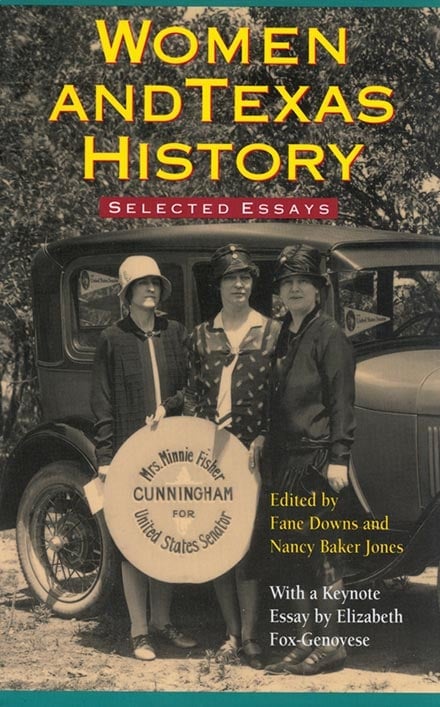
Florence King Long Fall: Pioneer of Women's Clubs and Art Patron in Texas (ca. 1864–1935)
By: Caroline Hassell
Published: July 17, 2024
Updated: July 18, 2024
Florence King Long Fall, Texas clubwoman and art patron, the daughter of John and Mary (Manahan) King, was born probably in March 1864 in Robertson County, Texas. Daughters of the American Revolution (DAR) sources give Wheelock, in Robertson County, as her place of birth. Her death certificate listed her date of birth as August 10, 1861, but the 1870 census listed her age as six, when the family was living in Bryan and her father worked as a farmer. In 1880 Florence, listed as fifteen years old on the census, lived with her family in Milam County.
Florence King married Henry L. Long of Beaumont on November 26, 1884. In Beaumont, she became active in club work, including the Beaumont Literary Club, with her mother-in-law, Sarah Long. During the World’s Fair in St. Louis in 1904, she served as hostess for a week and organized the activities at the Texas Building. She was a charter member of the Texas Woman's Press Association (see TEXAS PRESS WOMEN), and in her position as vice president with the Texas Women’s Press Club, she attended the World’s Fair for three months. She also served as a district vice president of the Texas Federation of Women’s Clubs by 1904.
After the death of her husband in 1902, Florence King Long married Henry B. Fall, the widower of her deceased sister-in-law, on June 28, 1905. After initially residing in Beaumont, the couple soon moved to Houston along with Henry’s son from his first marriage The couple had no children together. In Houston, Henry Fall worked as a lumber manufacturer, while Florence took up club work quickly and rose to the presidency of the City Federation of Women's Clubs of Houston in 1908. While she was president, the club published The Key to the City of Houston in December 1908. The publication provides a snapshot of the clubs, schools, hospitals, churches, and fraternal and social societies operating in Houston at that time. Her other club memberships during the course of her life in Houston included Current Literature Club, Ladies’ Reading Club, John McKnitt Alexander Chapter of the DAR, Young Women’s Christian Association (treasurer for four years), American Red Cross, Texas Fine Arts Association, and Houston Artists Gallery.
In January 1914 Governor Oscar B. Colquitt appointed Fall to a committee to raise funds for the Panama-Pacific Exposition to be held in San Francisco; she served on this committee for six months. The Texas Building opened at the Exposition in March 1915.
Fall was elected president of the State Federation of Women’s Clubs in Texas in November 1913. During her two-year term as president, 100 new clubs were added to the State Federation, bringing the total to 400 clubs with 16,000 women statewide. A primary focus of her administration was the passage of a compulsory education law in Texas. She published a lengthy statement regarding this issue in the January 2, 1915, edition of the Austin Daily Statesman:
Let every club woman in Texas work for a compulsory education law….Since now there are only six States that have no compulsory education law, since we have been taught by our forefathers that ‘education is the safeguard of a republic,’ since wise child labor laws are essential to successful compulsory education legislation, I earnestly recommend that the Texas Federation of Women’s Clubs concentrate all its force in obtaining from the next Legislature both child labor and compulsory education legislation.
In 1915 Fall and Anna J. Hardwicke Pennybacker (president of the General Federation of Women’s Clubs) both testified before the Texas legislature to promote a compulsory education bill. Fall and others were in the gallery of the Texas House of Representatives later in the session when the Thirty-fourth legislature successfully passed a compulsory education law. She also testified for continued state funding to augment the private fundraising for the Girls’ Training School in Gainesville, which was intended to provide training for delinquent girls in the court system (see GAINESVILLE STATE SCHOOL FOR GIRLS).
As her term concluded, she turned her attention back to Houston. The Houston Art League (originally founded in 1900 as the Houston Public School Art League) wanted to make art available to the general public and not just school children. The organization set a goal of opening the first art museum in Houston (see MUSEUM OF FINE ARTS, HOUSTON). In the summer of 1916 the Houston Art League secured property at South Main Street and Montrose from the George Hermann estate with funding from Joseph Cullinan and his wife. Florence Fall was elected president of the Houston Art League on October 31, 1916, and she continued the work of fundraising for a permanent building. A dedication of the land was scheduled for April 12, 1917, but fundraising for the museum was largely put on hold due to World War I. After the war, Fall and the board continued to keep the future art museum in the public’s view, with annual re-dedications on April 12th each year; the day came to be known as “Founders Day.” In January 1920, twenty-six oak trees surrounding the eventual museum’s south-facing entrance were donated, dedicated, and planted, with many Houston area clubs and donors represented.. When the art museum finally opened on April 12, 1924, Fall stepped down from the presidency but remained vice president of the board until her death.
In her other club work, Fall kept the art museum always at the forefront. In her DAR chapter, her passion for the museum made donations to it an annual chapter event, with either a furniture fixture donation or artwork. One of the museum’s first watercolors (a piece by museum director James Chillman) was donated by her DAR chapter. True to the Houston Art League’s original mission to art education for children, beginning in 1929 her DAR chapter donated to the fund for free art classes for Houston high school students annually.
Florence King Long Hall died in Houston on February 17, 1935. She was buried in Glenwood Cemetery. At her death, her DAR chapter and the City Federation of Women’s Clubs initiated the Florence Fall Memorial Fund to continue and expand the free children’s art classes. The initial funding came from a lottery sale of twenty-five art pieces, including donations from renowned Houston artists Grace Spaulding John and Emma Richardson Cherry (a founder of the original Public School Art League), among others. With the endowed memorial fund, the classes were expanded to provide 100 Houston-area students with free art classes at the museum. These classes, funded by the Florence Fall Memorial Fund continued at least until the early 1950s.
Bibliography:
Austin American, February 18, 1936. Austin Daily Statesman, January 29, 1914; January 23, 24, 1915. Austin Statesman, July 2, 1905. Mrs. Henry Fall, ed., and Mabel F. Smith, illust., The Key to the City of Houston (Houston: Federation of Women's Clubs, 1908). Galveston Daily News, March 1, 1896. History of the Texas Federation of Women's Clubs (Vol. 1., ed. Stella L. Christian, Houston: Texas Federation of Women's Clubs, 1919; Vol. 2., ed. Fannie C. Potter, Denton: Texas Federation of Women's Clubs, 1941). Houston Art League Scrapbooks, Museum of Fine Arts Houston Archives. Houston Chronicle, February 18, 1935. Houston Post, January 28, 1920.
Categories:
Time Periods:
Places:
The following, adapted from the Chicago Manual of Style, 15th edition, is the preferred citation for this entry.
Caroline Hassell, “Fall, Florence King Long,” Handbook of Texas Online, accessed March 09, 2026, https://www.tshaonline.org/handbook/entries/fall-florence-king-long.
Published by the Texas State Historical Association.
TID:
FFA27
All copyrighted materials included within the Handbook of Texas Online are in accordance with Title 17 U.S.C. Section 107 related to Copyright and “Fair Use” for Non-Profit educational institutions, which permits the Texas State Historical Association (TSHA), to utilize copyrighted materials to further scholarship, education, and inform the public. The TSHA makes every effort to conform to the principles of fair use and to comply with copyright law.
For more information go to: http://www.law.cornell.edu/uscode/17/107.shtml
If you wish to use copyrighted material from this site for purposes of your own that go beyond fair use, you must obtain permission from the copyright owner.
- July 17, 2024
- July 18, 2024
This entry belongs to the following special projects: