Discover Floresville: The Peanut Capital of Texas
Published: 1976
Updated: September 22, 2023
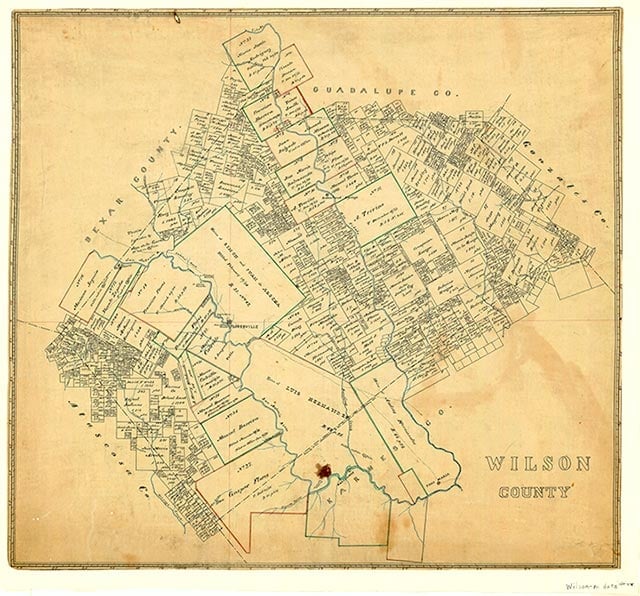
Floresville, the county seat of Wilson County, is at the junction of U.S. Highway 181 and State Highway 97, thirty miles southeast of San Antonio in the central portion of the county. The area was settled by Canary Island immigrant Don Francisco Flores de Abrego, who established a ranch headquarters six miles northwest of the site of present Floresville in the eighteenth century. In 1833 the nucleus of the town included the Flores home, a chapel, and a graveyard. The community was called Lodi and served as the Wilson County seat from 1867 to March 1871, and again from July 1871 to 1873. In 1867 Floresville, named for the Flores family, was founded; its site included part of the area known as Lodi. In the early 1870s a townsite was surveyed and laid out. At that time a prominent citizen, Andrew G. Pickett, who owned a ranch with an irrigation system, started raising peanuts. A Floresville post office was established in 1872. In November 1873 county voters made Floresville the county seat. In the 1870s Floresville Academy offered several levels of education. Development accelerated in 1883, when the San Antonio and Aransas Pass Railway announced plans to construct a line through the town. By 1885 Floresville had two hotels, several stores, a weekly newspaper named the Chronicle, two steam cotton gin-gristmills, and a population of 400. The town was incorporated in 1890, when the reported population was 1,500. A five-teacher school was in operation by 1896, when it had an enrollment of 206.
The town continued to grow during the early years of the twentieth century, supported by both the cotton and livestock industry, and by 1910 it had two banks and a population of 1,800. Peanuts were developed as a cash crop in the surrounding region around 1915 and in later years residents nicknamed Floresville the "Peanut Capital of Texas." Between 1930 and 2000 the town grew steadily, from 1,581 residents in 1931 to 1,935 in 1952; 2,980 in 1965; 5,414 in 1990; and 5,868 in 2000. There were 342 rated businesses in 2000. The town serves a market center for area peanut, small grain, and cattle producers. Many residents now commute to work in San Antonio. Floresville is best known for its annual Peanut Festival, started in 1938, which attracts 10,000 to 15,000 visitors each year.
Bibliography:
Louise Stadler, ed., Wilson County History (Dallas: Taylor, 1990).
Categories:
Places:
The following, adapted from the Chicago Manual of Style, 15th edition, is the preferred citation for this entry.
Claudia Hazlewood, “Floresville, TX,” Handbook of Texas Online, accessed March 09, 2026, https://www.tshaonline.org/handbook/entries/floresville-tx.
Published by the Texas State Historical Association.
TID:
HGF03
- 1976
- September 22, 2023