History of Red Bluff, Texas: From Karankawa Camps to Decline
Published: March 1, 1995
Updated: September 28, 2020
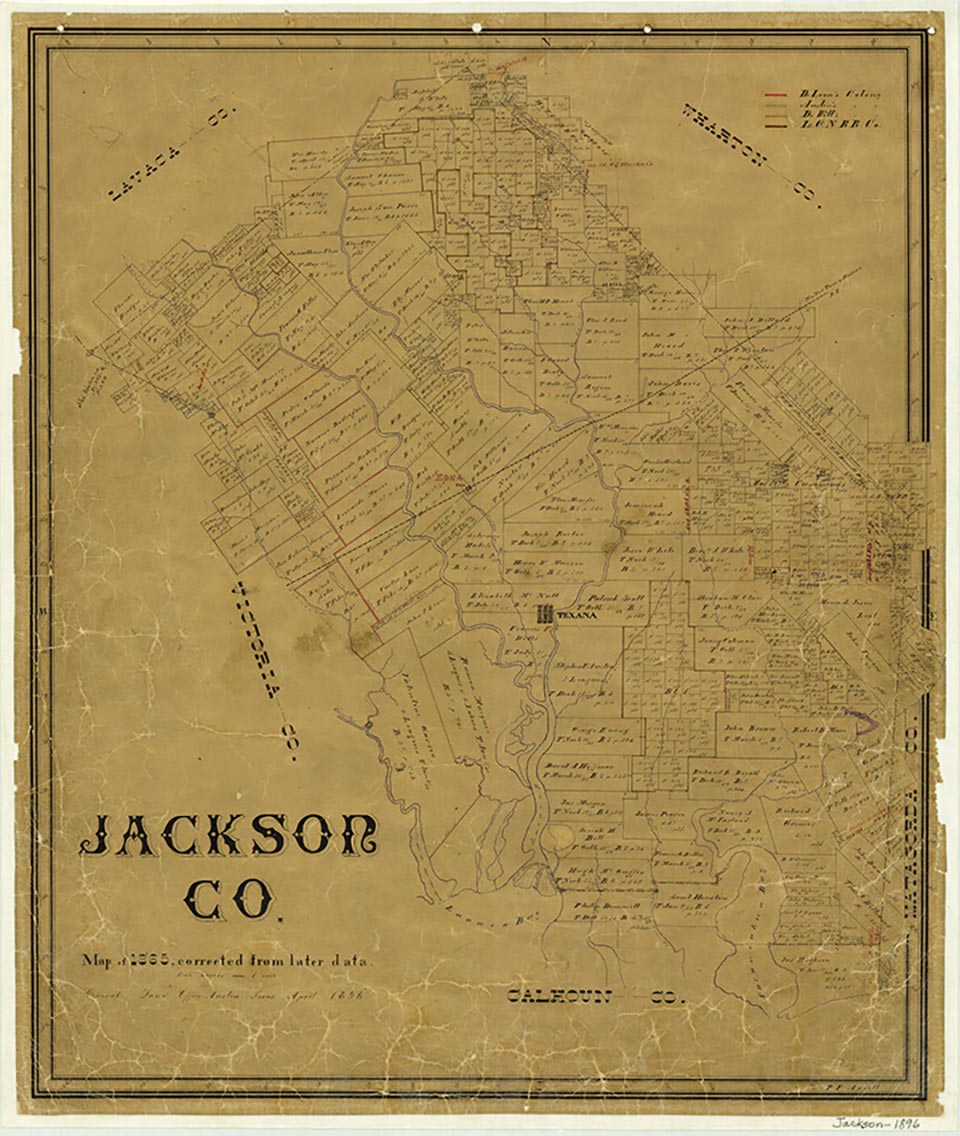
Red Bluff (Redbluff) overlooked the east bank of the Navidad River eleven miles southeast of Edna in Jackson County. Before the arrival of European settlers, Karankawa Indians camped on the elevated ground above the river, where they were safe from floodwaters and enemies. As early as 1690 Manuel José de Cárdenas y Magaña explored the Red Bluff area. In the 1820s Sylvanus Hatch, accompanied by a few Blacks and an Indian guide, reconnoitered the area; Hatch was probably the first American to do so. In October 1830 Patrick Scott, an Irish settler, obtained a Mexican land grant in the Red Bluff vicinity. Scott died in 1835, leaving his lands to his children. In November 1830 American colonist Jesse White received the second grant in the area. White died in 1842, apparently without developing his land.
Also in 1830 empresario Stephen F. Austin acquired a two-league grant along the Navidad River and had hoped to colonize the Red Bluff site. Austin died, however, before his plans came to fruition. After Austin's death the Red Bluff section passed to James Franklin and Emily Austin Perry, Austin's sister and brother-in-law. The Perrys held the land until 1849, when they sold it to James P. DuPrey, who ranched there until 1880. DuPrey sold a portion of his spread to R. F. Clement, who also raised cattle on the acreage. Clement, however, did not find ranching as profitable as he had hoped and divided his holdings into small farming tracts.
Clement laid out a townsite with the self-commendatory name of Clement. No one else, however, used that appellation, preferring Red Bluff, after the russet clay bluff that towered almost 100 feet above the Navidad River. During the winter of 1894–95 the settlement was first recorded by that name, and the establishment of the town can be traced to that date. The first business was Webb's General Merchandise Store, which provided most of the community's needs. In 1896 residents erected a schoolhouse, and a post office named Redbluff was established the next year. In 1898 Red Bluff comprised some seven domiciles and about six businesses.
The St. Louis, Brownsville, and Mexico Railway bypassed Red Bluff and constructed a switch at nearby Lolita in 1909. Thereafter, Red Bluff's population declined sharply. The businesses, beginning with the gin, were moved to Lolita. The post office closed in 1915, essentially bringing an end to Red Bluff as a viable community. By 1948 Red Bluff had ceased to be listed on county road maps. In 2000 the population was thirty-five.
Bibliography:
Ira T. Taylor, The Cavalcade of Jackson County (San Antonio: Naylor, 1938).
Places:
The following, adapted from the Chicago Manual of Style, 15th edition, is the preferred citation for this entry.
Stephen L. Hardin, “Red Bluff, TX (Jackson County),” Handbook of Texas Online, accessed March 09, 2026, https://www.tshaonline.org/handbook/entries/red-bluff-tx-jackson-county.
Published by the Texas State Historical Association.
TID:
HRR56
- March 1, 1995
- September 28, 2020